
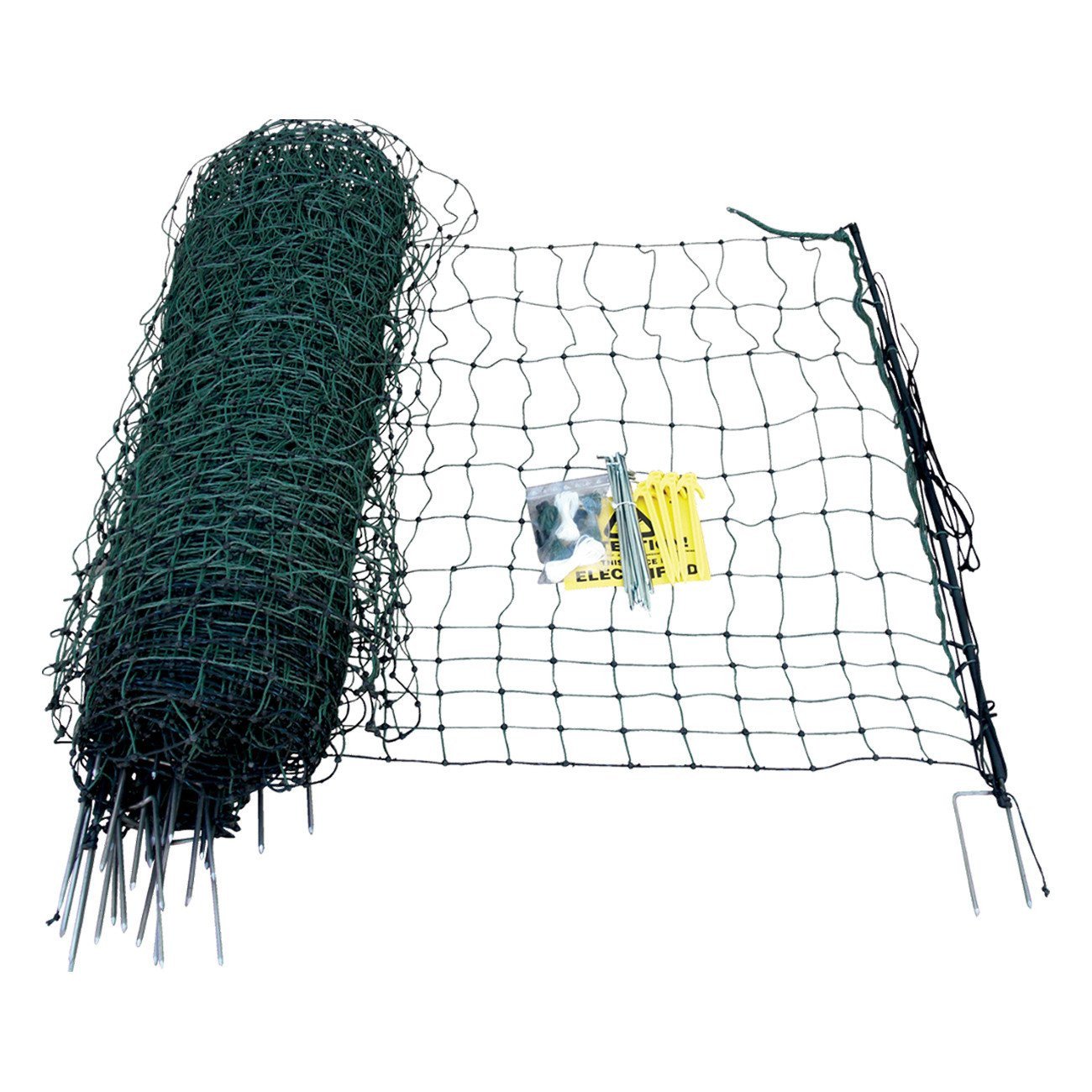
Electric netting is the quickest way to put a predator-resistant fence around chickens, ducks, sheep or goats without driving a single post. A roll comes with the posts already woven in: you unroll it, step the spikes into the ground, clip an energizer to the lead and you have a fence. This guide explains how the nets Pipestone Farm Supply sells differ, what the manufacturers say each one is for, how to power and ground a net so it actually carries a charge, and the mistakes that leave a net dead on the ground. Every specification below comes from the manufacturer's product page or instruction sheet; the sources are listed at the end.
What electric netting is and what it is not
A net is a mesh of horizontal conductive strands and vertical plastic struts, hung on plastic posts with metal ground spikes. The energizer sends a short high-voltage pulse down the horizontal strands. An animal that touches a live strand while standing on the ground closes the circuit and gets a brief shock, and learns to stay away. Premier 1, one of the largest netting makers, puts it plainly: the birds and ground predators "receive a high-voltage shock from the brief electric pulse and learn to avoid it."
That last word matters. Netting is a psychological barrier, not a physical one. It works on animals that have been taught to respect it, and it does nothing against hawks, owls or eagles. Premier 1's guidance is that netting deters ground predators such as dogs, coyotes, raccoons, skunks and foxes, and, in its words, "Won't stop aerial predators (e.g. hawks, eagles, owls, etc.)" If you lose birds to hawks you need overhead cover, not a taller net.
The nets on pipestonefarmsupply.ca
Pipestone lists seven electric nets on the electric netting page, from two brands. Heights and post counts below are the manufacturer's own figures.
Patriot Poultry Netting, 164 ft roll. Patriot's specification is 164 ft long by 40 in high, with 15 built-in posts spaced 12 ft apart and 12 horizontal wires. This is the general-purpose chicken and duck net. Listed as the Patriot Poultry Netting 165 x 43.
Patriot Sheep & Goat Netting, 164 ft roll. Patriot's specification is 164 ft by 35 in, 14 posts spaced 12.5 ft apart, 8 horizontal wires. It is shorter and has fewer strands than the poultry net because sheep and goats are bigger targets than a hen, but the wider spacing between strands is not meant for poultry. Listed as the Patriot Sheep & Goat Netting 165 x 35.
Patriot Positive/Negative Netting, 164 ft and 50 ft. Patriot's specification for the long roll is 164 ft by 40 in with 18 posts spaced 10 ft apart and 12 horizontal wires; the short roll is 50 ft by 40 in with 6 posts. The difference from a standard net is inside the strands, explained in the next section. Listed as the Patriot Positive/Negative Netting 164 and the Patriot Positive/Negative Netting 50.
Corral Poultry Netting, 50 m rolls. Corral's poultry net is 50 m (164 ft) long and 1.06 m high, with 11 horizontal lines of which 10 are electrified, a strengthened top strand and, in the manufacturer's words, a "particularly small mesh width in the lower area of the net" with verticals every 3 in to stop chicks and small predators slipping through. The manufacturer lists it for hens, geese and turkeys and says it is also suitable for lambs. Pipestone lists three versions: the double-prong 106 cm net, the double-prong 122 cm net for birds that fly, and the lighter single-prong 106 cm net. Double-prong posts have two ground spikes and stand up better in wind and on uneven ground; single-prong posts are quicker to push into soft soil and lighter to carry.
Kerbl OviNet and PoulNet, 50 m rolls. We also list two Kerbl nets that are filed outside the netting page: the Kerbl OviNet orange single prong (90cm x 50m), a sheep net, and the Kerbl PoulNet orange single prong (112cm x 50m), a poultry net. The figures in each name are the net's height and roll length. Both have single-prong posts; the double-prong versus single-prong trade-off above applies to them too.
Standard nets versus positive/negative nets
On a standard net every horizontal strand except the bottom one is live, and the circuit is completed through the soil: the animal stands on the ground, touches a live strand, and the pulse travels through its body and the earth back to the energizer's ground rod. That works well in moist soil. It works poorly on dry, sandy, frozen or snow-covered ground, because dry soil is a bad conductor and the animal barely feels the pulse.
A positive/negative net solves that by alternating live (positive) and grounded (negative) strands. The Patriot/Kencove instruction sheet for positive/negative netting says that an animal "pushing between the orange and green earth lines will receive shock regardless of ground conditions," and recommends this type of net for "dry regions or for ultimate control." The trade-off is that you connect two leads instead of one: the positive bundle to the energizer's fence terminal and the negative bundle to the ground rod. The same sheet warns never to cross the two, because "when earth lines (neg) touch live lines (pos), the fence will short out." For a central Alberta acreage the standard nets are fine from spring thaw to freeze-up; the positive/negative net is the one to choose if you run netting on frozen ground, on gravel or sand, or in a dry summer when a standard net keeps reading low.
Choosing the height and the animal
Match the net to the animal the manufacturer names. The 40 in and 106 cm poultry nets are made for chickens, ducks and turkeys; the 122 cm Corral net adds height for birds that get over a metre-high fence. The 35 in Patriot sheep and goat net is for sheep and goats. Corral says its poultry net is also suitable for lambs, but the reverse is not true: a sheep net's wide strand spacing will not hold hens or chicks.
Premier 1 notes that hens which keep flying out can be discouraged by clipping the flight feathers on one wing, which "doesn't hurt the bird, but reduces its ability to take flight" over 42 to 48 in fencing. Pipestone does not sell a net for large livestock: cattle and horses belong on a strand fence sized with our energizer sizing guide.
Powering the net
Netting has far more conductor per metre than a single strand fence, and it sits in grass, so it needs a stronger pulse than its length suggests. Corral's recommendation for its 50 m poultry net is a "minimum 2 joule energizer" for effective predator control. The Patriot/Kencove positive/negative sheet gives a lower floor ("minimum of .25 joule per net") and says "the fence must have at least 3,000v on the voltage test meter at the farthest point from the energizer." Premier 1 recommends a 0.6 joule unit or larger for up to three rolls and adds that smaller units may work for one or two rolls only "if grass contact is kept to the absolute minimum." Follow the recommendation printed on your net and test the voltage; between manufacturers, the consistent message is that grass contact is what drains a net, so buy more energizer than the bare minimum if you will not be mowing.
Pipestone lists the Patriot P5, P10, P20 and P30 dual-purpose chargers, which run from 110 V mains or a 12 V battery, and the Corral Sun Power S-10 and S-15 solar units for a net with no power nearby. Check the output joule figure on each product page against your net's recommendation. Use only a pulse energizer; Premier 1's instruction is: "Do NOT use an energizer that is labeled high impedance, continuous current, weed burner or weed chopper."
Grounding is half the fence
A weak ground is one reason a new net can read low. The BC Ministry of Agriculture fencing factsheet on grounding systems calls for a minimum of three galvanized ground rods, 6 ft by 5/8 in, spaced 6 ft apart, connected to the energizer with bare copper wire. For very dry sites it describes a wire-return system, which is exactly the principle the positive/negative net builds in. Pipestone lists the Patriot 5 ft ground rod kit with three rods, three clamps and lead wire, and the Corral T-shaped 1 m ground rod for a short portable net. Drive rods into the dampest ground you have, not the nearest, and keep them well away from any building ground or water line.
Setting up a roll
Turn the energizer off before you touch the net; the positive/negative instruction sheet says to "turn OFF the energizer before dismantling electric netting" and the same applies to setting it up. Walk the perimeter first and mow or trample the strip where the net will stand. Unroll the net with the posts on the outside of the roll, stand the posts up one at a time and push the spikes in fully, pulling the net taut between posts so the bottom strand does not sag into the grass. Use a plain support post at each corner if the net leans. Connect the lead to the fence terminal, connect the ground rod, switch on and read the voltage with a tester at the far end of the net. Pipestone lists the Patriot digital voltmeter, the Patriot six-light fence tester and the Speedrite digital fault finder, which points you toward a short instead of making you walk the fence.
Mistakes that leave a net dead
Grass is the big one. Premier 1's advice is to mow when grass reaches 6 in, and moving a net onto a mowed strip "takes approx. 5 minutes per roll of net." A net left in tall wet grass can lose most of its voltage even on a large energizer. Second is the ground: one short rod in dry dirt will not carry a pulse. Third is untrained animals: introduce new birds or lambs to the net where they can see it and get their first touch while you are watching, and keep the net powered all the time, because animals test a dead fence within a day. Fourth is entanglement: never leave a net unpowered with animals inside, and be careful with horned goats and sheep, which can catch in an unpowered net. Fifth is people: Premier 1 warns to keep toddlers away from electrified fences and to avoid head and neck contact with live wires. Post a warning sign where the public can reach the fence.
Winter
Snow and frozen ground stop a standard net from working well, because the circuit through the soil fails. If you keep birds out on netting through an Alberta winter, use the positive/negative net and keep the strands clear of drifts. Otherwise pull the nets before freeze-up, coil them loosely with the posts together, and store them dry; the plastic struts are brittle in the cold.
Browse the full electric netting range, the Patriot and Corral brand pages, or the energizers and chargers page. Orders ship Canada-wide from Millet, Alberta, or pick up in store.
For ground rods, insulators, gate cable, testers and warning signs on a permanent or polywire fence, see our guide Electric Fence Supplies Checklist: Ground Rods, Insulators, Gates and Testers.
Sources: Patriot product pages for 164ft Poultry Netting, 164ft Sheep & Goat Netting, 164ft and 50ft Positive/Negative Netting (patriotglobal.com); Corral poultry netting specification as published by the manufacturer's Canadian distributors; Kencove/Patriot Positive/Negative Electric Netting Instruction Manual (2013); Premier 1 Supplies, "What is poultry netting?"; BC Ministry of Agriculture Fencing Factsheet 307.320-1, Grounding Systems for Electric Fences.