Every fall we get the same two questions at the counter in Millet: "Do I want Killex or Roundup?" and "What's the mix rate on the Killex concentrate?" The first one has a clear answer. The second one is on the label, and we'll tell you where to look and why we won't guess it for you.
Key takeaways from the labels
- Killex is selective; Roundup is not. Killex is registered for broadleaf weeds in turf; Roundup's core products are labelled Non-Selective Herbicide.
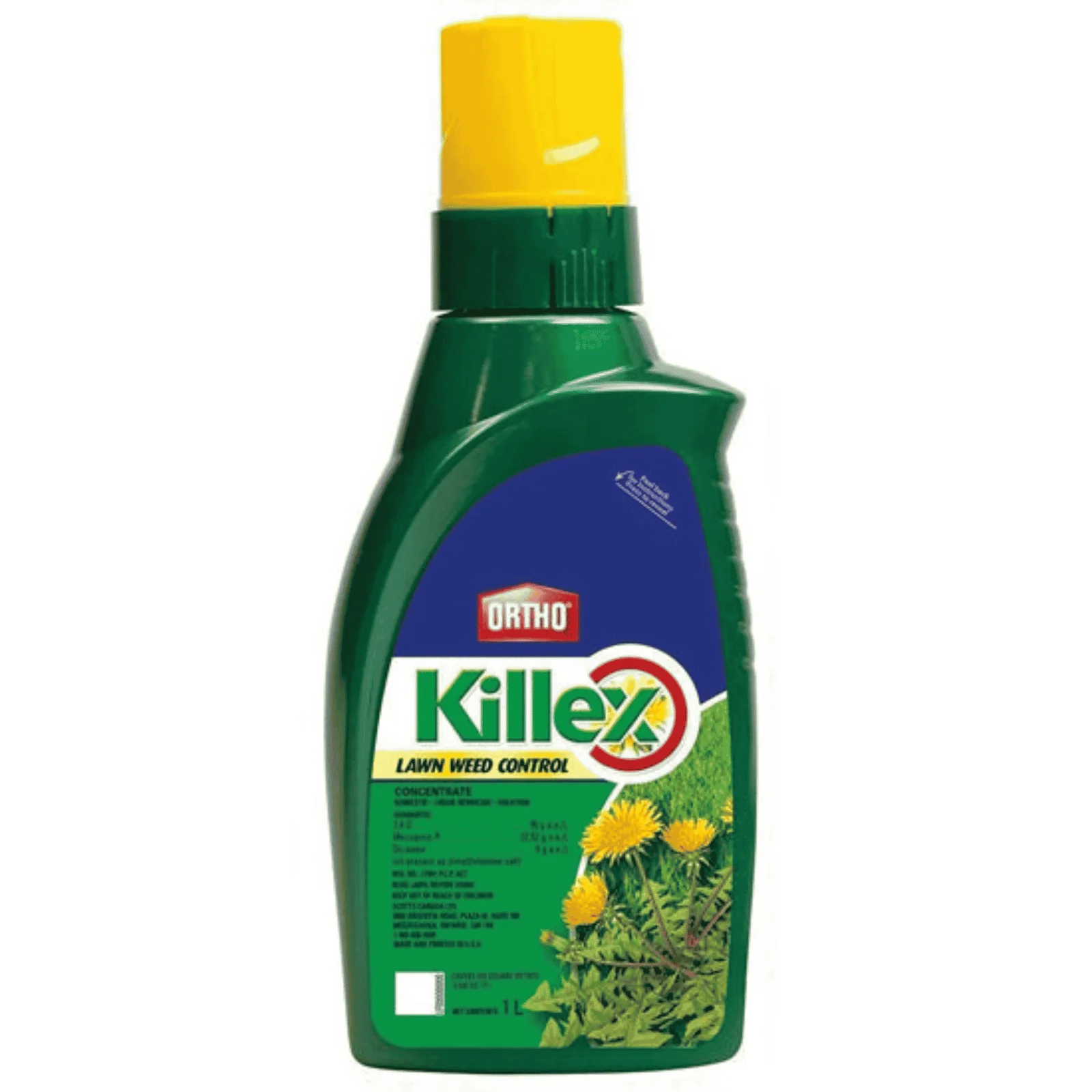
- The Killex concentrate label (PCP 27801) lists 2,4-D 95 g a.e./L, mecoprop-P 52.52 g a.e./L and dicamba 9 g a.e./L; the ready-to-use bottles carry the same three actives pre-diluted.
- "DO NOT water within 24 hours after application" appears on every Killex label we carry, and the concentrate label adds "Do not apply when rain is expected."
- Two broadcast applications per season is the maximum on the concentrate label, and it says "Do not apply to newly seeded lawns until after 3rd mowing."
- Check your province, city or town before you buy: Health Canada registers Killex federally, but provinces and municipalities can restrict cosmetic lawn use.
The one-sentence difference
Killex is selective. Roundup is not. Ortho Killex is a lawn weed killer that targets broadleaf weeds, but its labels still carry grass cautions: bentgrass and newly seeded lawns (quoted below). Roundup's core products are labelled Non-Selective Herbicide — they kill grass as readily as weeds. Spray Roundup on a dandelion in the middle of the lawn and you will get a dead dandelion in the middle of a dead patch.
So: weeds in the lawn → Killex (or Scotts Weed B Gon, below). Weeds where you want nothing growing at all — gravel driveways, fence lines, under decks, cracks in paving, or a bed you are clearing before replanting → Roundup.
What Killex actually is
The Ortho Killex Lawn Weed Control Concentrate label lists three active ingredients, all present as dimethylamine salt: 2,4-D 95 g a.e./L, mecoprop-P 52.52 g a.e./L and dicamba 9 g a.e./L, and it is registered under the Pest Control Products Act as PCP number 27801. The weeds it is registered for are listed on the label itself; our guide What weeds does Killex control? The full label list, creeping Charlie to thistle sets out that list. The label's timing line is short: "This product is only effective when applied to the leaves of actively growing weeds."
Ortho also notes that Killex is "not available in all provinces." It is sold in Alberta, which is why you will find it on our shelf; some other provinces and a few municipalities restrict cosmetic 2,4-D use, so if you are buying for a lawn elsewhere, check locally first.
The four Killex formats we carry, and who each one suits
Ortho Killex Lawn Weed Control Concentrate 1 L — the economical choice for a whole lawn or an acreage yard. Ortho rates the 1 L bottle at 800 m² (about 8,800 sq ft) of coverage. You mix it with water in a hand-held or backpack sprayer, or run it through a Scotts Dial 'N Spray hose-end applicator, which dilutes as it goes. The bottle has a built-in measuring cap. It works as a broadcast treatment over the whole lawn or as a spot treatment. Its Health Canada registration is PCP 27801; the guarantee is 2,4-D 95 g a.e./L, mecoprop-P 52.52 g a.e./L, dicamba 9 g a.e./L.
Ortho Killex Ready-To-Spray Lawn Weed Control 1 L — the same job with no measuring: it attaches to a garden hose and mixes itself. Its label says it "COVERS 800 sq. metres (8,800 sq. ft.)". It has its own registration, PCP 27809, with the same guarantee as the concentrate (2,4-D 95 g a.e./L, mecoprop-P 52.52 g a.e./L, dicamba 9 g a.e./L), and its label says the bottle "COVERS 800 sq. metres (8,800 sq. ft.)" and "Do not apply when rain is expected."
Ortho Killex Ready-To-Use Lawn Weed Control 709 mL — a trigger spray for spot-treating a handful of weeds. No mixing, no sprayer to clean. Registered as PCP 27800 at a pre-diluted strength of 2,4-D 1.9 g a.e./L, mecoprop-P 1.05 g a.e./L and dicamba 0.18 g a.e./L; the label's directions are "Aim at weed; pull trigger. Only short burst necessary," and it warns that "Rain within 6 hours reduces effectiveness."
Ortho Killex Ready-To-Use with Wand Applicator 4 L — pre-mixed like the trigger bottle but in a jug with a wand, so you can spot-treat a lot of weeds without bending over or refilling. It is a separate registration, PCP 30541, at the same pre-diluted strength as the trigger bottle (2,4-D 1.9 g a.e./L, mecoprop-P 1.05 g a.e./L, dicamba 0.18 g a.e./L); the label says to "Aim at centre of unwanted weeds and spray to lightly cover."
"What's the mix rate for Killex concentrate?"
It is printed on the back label of the bottle, in a table by application method, and it is the only number you should use. Rates on pesticide labels are legally binding directions in Canada, they are specific to the exact registration number on your bottle, and manufacturers do change them between label versions. Here is what to look for on the Killex Concentrate label when you have it in hand:
- the millilitres of concentrate per litre of water for a hand or backpack sprayer, and the area that mix covers;
- the setting to use on a Dial 'N Spray hose-end sprayer if that is how you apply it;
- the maximum number of applications per season and the minimum interval between them;
- the re-entry direction (when people and pets can go back on the lawn), and any guidance on rain, mowing and watering around the application;
- the drift cautions — 2,4-D and dicamba labels warn against letting spray or mist reach flowers, vegetables, shrubs and trees, so spray on a still morning.
If your bottle's label is worn or missing, the Ortho Canada product page for the concentrate is the manufacturer's reference, and the store can look up the current label for you.
Where Roundup fits
Our Roundup range is all in the weed and moss control category, and the labels fall into three groups:
- Concentrates for mixing — Roundup Concentrate Non-Selective Herbicide 1 L and 500 mL, Roundup Super Concentrate 1 L and Roundup Advanced Concentrate 1 L. These are for large areas: fence lines, corrals you are clearing, gravel yards, driveways.
- Ready-to-use jugs and sprays — Roundup Ready-To-Use with Wand Applicator 4 L (and the 4 L refill), Roundup Advanced Ready-To-Use with Pump N Go 5 L, and the FastAct Foam 1 L and 2 L sprays, which come out as a foam.
- Roundup Ready-To-Use Tough Brush & Poison Ivy Control with Wand Applicator 4 L — a separate formulation labelled for woody brush and poison ivy rather than lawn weeds. If poison ivy is coming up in the lawn, note that it is also on the Killex weed list; if it is in a fence line or bush edge where you do not care about the grass, this is the Roundup to reach for.
As with Killex, the label on the jug carries the rate, the timing and the re-entry direction, and every one of these products is regulated as a pesticide by Health Canada. Read the label, keep people and pets off treated areas as it directs, and do not spray near open water.
Which of these contain glyphosate, and which do not? Our guide Which Roundup Has Glyphosate? sorts all eleven by the active ingredient and guarantee on Health Canada's register and quotes each concentrate's mix rate from its label.
Weed B Gon: the third option
If you would rather not use 2,4-D on your lawn, Scotts Weed B Gon MAX is the other selective lawn weed control we list, in concentrate 1 L, concentrate 500 mL, ready-to-spray 1 L and ready-to-use 1 L. It is a different chemistry with its own label and its own weed list, so read it the same way. For moss rather than weeds, Scotts also makes Moss B Gon MAX 3-in-1.
Is Killex legal in Canada and Alberta? Why do people say it is "banned"?
Killex is registered federally by Health Canada (PCP 27801), and it is sold for lawn use in Alberta — you can buy it at our Millet store or online. The "banned" talk comes from the provinces that restrict lawn, or "cosmetic", use of pesticides. Health Canada explains that "provinces and territories can create laws about property, civil rights, and matters of local interest. This includes creating cosmetic pesticide bans to prevent the use of some pesticides," and that "cities, towns, and municipalities may be given the power by provinces and territories to regulate how pesticides are used locally." Where such rules exist, Killex is hard to find in stores, which is why searches like "why is Killex banned in Canada" exist. Rules are set province by province and sometimes town by town, so Health Canada's advice stands: "To see if there is a ban on lawn pesticides where you live, contact your province, city, or town." If you are ordering from outside Alberta, check your province first — the same federal label applies everywhere, but provincial use rules do not.
Why is Killex banned in Ontario?
Ontario is the province most of those searches mean. The Ontario government's page on pesticides for home lawns and gardens says that, by law, certain pesticides cannot be used to kill weeds and insects on lawns, vegetable and ornamental gardens, patios, driveways, parks and schoolyards, and that "You cannot use pesticides that contain certain ingredients, including:" 2,4-D, Diazinon and glyphosate. It gives the reason as: "These pesticides are banned for cosmetic purposes because they may pose an unnecessary risk to human health, particularly children’s health." 2,4-D is one of Killex's three actives, and glyphosate is the active in many Roundup products. The same page lists health and safety exceptions, such as poison ivy and giant hogweed, and names the law behind the rule (the Pesticides Act and Ontario Regulation 63/09) — read it at ontario.ca before relying on any exception.
Quick decision list
- Dandelions, clover, plantain or creeping Charlie in the lawn → Killex (concentrate for big lawns, ready-to-spray for a town lot, ready-to-use for a few spots).
- Weeds in gravel, paving, fence lines or a bed you are clearing → Roundup.
- Poison ivy in the lawn → Killex lists it; in brush or fence lines → Roundup Tough Brush & Poison Ivy.
- You want to avoid 2,4-D on the lawn → Scotts Weed B Gon MAX.
- Fall timing on the prairies → while weeds are still green and actively growing, before the first hard freeze.
Does Killex kill grass, and which weeds does it control?
The registered Killex label (PCP 27801) does not list any lawn grass as a target. Its only grass cautions are "Do not use on bentgrass varieties (golf greens)." and "Do not apply to newly seeded lawns until after 3rd mowing." What it does list is "OVER 50 DIFFERENT LAWN WEEDS" by name — dandelion, plantain, clover, ground ivy (creeping Charlie), Canada thistle, ragweed and more. We reproduced the whole list from the Health Canada label in What weeds does Killex control? The full label list.
Does Killex kill moss? Moss is not on that list. The only "mossy" entry on the label is "stonecrop (mossy)", a broadleaf plant, so we will not say Killex controls moss.
All of these are listed at Pipestone Farm Supply in Millet and ship across Canada from our Ortho, Roundup and Scotts brand pages.
Sources: Health Canada, "Cosmetic pesticide bans" (canada.ca); Ontario government, "Pesticides (home lawns and gardens)" (ontario.ca); Health Canada PMRA registered labels for Ortho Killex Concentrate (PCP 27801), Ready-To-Spray (PCP 27809), Ready-To-Use (PCP 27800) and Ready-To-Use with Wand Applicator (PCP 30541) (pr-rp.hc-sc.gc.ca); Ortho Canada product pages for Killex Lawn Weed Control Concentrate and Ready-To-Use (scottsmiraclegro.com/en-ca); Ortho Killex Lawn Weed Control Concentrate Safety Data Sheet (active ingredients, PCP registration number 27801, hazard statements); product names as registered on the Roundup and Scotts labels. This article describes what the labels say; it is not a substitute for reading the label on the product you buy.