The Scotts Quick + Thick label names early spring and early fall as the best times to plant, and ties germination to soil temperature. This guide walks through why fall overseeding works, how to read the Scotts label so you seed at the right temperature and rate, which of the grass seed products we list at Pipestone Farm Supply fits which lawn problem, and what to do in the two weeks after the seed goes down. Everything about the products comes from the Scotts Canada label pages; the agronomy comes from a university extension factsheet, both linked at the end.
Why fall beats spring on the prairies
The grasses in every Canadian lawn mix - Kentucky bluegrass, creeping red fescue and perennial ryegrass - are cool-season grasses. Kansas State University's extension service sums up the fall advantage: cooler temperatures, shorter days and better soil moisture "create the perfect environment for strong root development", while the soil is still warm enough for fast germination. Spring seeding fights the opposite problem - cold soil, then heat and annual weeds arriving just as the seedlings are trying to establish.
The label on Scotts Turf Builder Quick + Thick Sunny Bluegrass Mix puts the same thing in numbers: "Early spring and early fall are the best times to plant. Seed germinates best when temperatures are consistently 15°-26°C (60° to 80°F)." Scotts EZ Seed Patch & Repair says to apply "when daily average soil temperatures are consistently between 15-26°C." Go by soil temperature, not the calendar. If you have missed the window, hold the bag and seed as soon as the soil warms next year rather than sowing into frozen ground.
Overseeding vs. patching vs. a new lawn
Overseeding is spreading seed over an existing but thin lawn to thicken it. It is the lowest-effort, highest-return job on this list and the one most Alberta lawns need after a dry summer. Patching is repairing a bare spot - a dog spot, a spot where a kiddie pool sat, winter salt damage along the driveway. A new lawn is seeding bare soil. The products below are grouped that way.
Overseeding a thin lawn
The seed needs to touch soil. K-State's advice is blunt: broadcasting seed onto compacted soil covered in thatch gives poor germination, so slice or rake grooves for the seed to fall into. On a home lawn that means mowing shorter than usual, raking hard to pull up dead material and expose soil, then spreading the seed and raking lightly again. Core aeration alone produces "a less uniform stand" than slicing, but aerating and then seeding heavily is still far better than nothing.
Two products on our grass-seed page are built for this job:
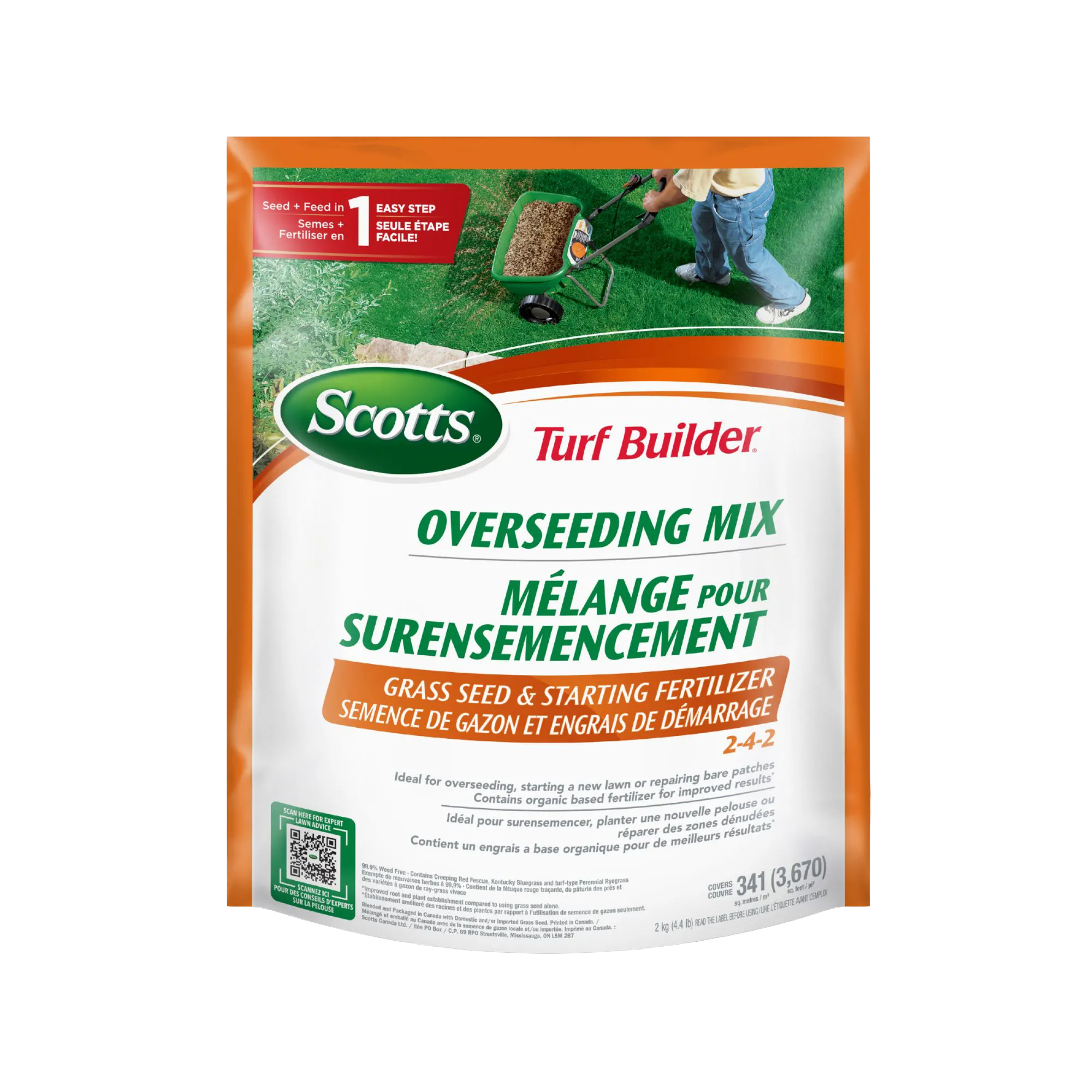
Scotts Turf Builder Overseeding Mix Grass Seed and Starting Fertilizer 2 kg - a seed and starter-fertilizer combination in one bag, covering up to 341 m² according to the listing. It is meant for a lawn that is thin overall rather than bare.
Scotts Turf Builder Quick + Thick Grass Seed Sun & Shade 1.2 kg - the label lists creeping red fescue, Kentucky bluegrass and turf-type perennial ryegrass coated with a 12-0-0 time-release nutrient blend. The 1.2 kg bag covers up to 173 m² when overseeding. Scotts' guidance is to apply "under cooler temperatures and less direct sunlight, in the early morning or evening", and the label carries one instruction people miss: "Wait at least 4 weeks before applying a nitrogen fertilizer" - the coating already supplies it.
The Quick + Thick line is sorted by site, so match the bag to the lawn: Sunny Bluegrass Mix for open, full-sun front yards (label coverage up to 191 m² per 1.2 kg), Dense Shade Mix under spruce and along north walls, Tough & Resilient Mix for the strip the kids and the dog run on, and Low Maintenance Mix for acreage lawns you mow less and never irrigate.
If you would rather buy seed without the fertilizer coating, the plain Turf Builder Grass Seed Sunny Areas Mix, Shady Areas Mix and All Purpose Mix come in 1 kg bags, as does the entry-level Scotts Grass Seed All Purpose Mix. Fafard's 1.2 kg bags - Sun & Shade, Dense Shade and Low Maintenance - carry a 12-0-0 fertilizer analysis in the name, so treat them as fertilized seed and check the bag before adding more nitrogen.
Repairing bare spots
For a spot smaller than a picnic blanket, a mulch-based patch product is easier than loose seed because the mulch holds moisture and keeps the seed from washing or blowing off. Scotts EZ Seed Patch & Repair 1.7 kg is a three-in-one mix of creeping red fescue, perennial ryegrass and Kentucky bluegrass, a mulch that Scotts says absorbs up to six times its weight in water, a controlled-release fertilizer and a tackifier. The label steps are short: remove the dead grass and loosen hard soil; "evenly apply Scotts EZ Seed so the area is mostly covered, but bare ground is still visible"; then "gently water the area until Scotts EZ Seed is completely saturated" - the mulch turns dark brown when it has enough water and lightens as it dries, which is your cue to water again. The 1.7 kg jug covers about 7.9 m² of bare ground, so it is a spot product, not an overseeding product. EZ Seed Dog Spot Repair 907 g is the same idea sized for the round dead patches dogs leave.
Scotts Lawn Response 9-1-1 is listed at 4.8 kg for 120 m² - a larger pack for lawns with many rough areas rather than one or two spots; check the bag for its own preparation and watering steps.
Something different: white clover
Scotts White Clover 1 kg is on the same shelf for people who want a low groundcover or a clover-grass blend on an acreage. Sow it into a grass lawn only if you are happy to have clover there permanently - it is not a patch product and it will not disappear.
The two weeks after seeding
Water is the whole job now. The Quick + Thick label says to "water daily until the seedlings reach 5 cm in height"; K-State describes the same pattern as "frequent, light irrigation" moving to "deeper, more infrequent watering" once the seedlings are up. Expect ryegrass and fescue to show in about ten days and bluegrass to take up to two weeks - so a mixed bag looks patchy at day ten and even at day fourteen, which is normal. Keep pets and children off the area until the seed has been watered in and the surface is dry (a Scotts label instruction), skip herbicides on new seedlings, and mow only once the new grass is tall enough that the mower takes off the top third and no more. Do not apply extra nitrogen for four weeks after a coated seed product, then feed with a fall lawn fertilizer from our lawn fertilizer page if the label timing still allows.
Our fall lawn fertilizer guide sets out what the Scotts labels say about timing and coverage for Fall Lawn Food 32-0-10 and the two starters.
Quick decision list
Whole lawn thin, not bare: Turf Builder Overseeding Mix, or a Quick + Thick bag matched to sun or shade. A few bare spots: EZ Seed Patch & Repair or Dog Spot Repair. Many rough areas: Lawn Response 9-1-1. Acreage or rarely watered: Quick + Thick Low Maintenance or Fafard Low Maintenance. Everything above is on our grass seed and patch repair page and the Scotts brand page, in store in Millet or shipped across Canada.
Sources: Scotts Canada product pages for Turf Builder Quick + Thick Sun & Shade (12552), Quick + Thick Sunny Bluegrass Mix (12665) and EZ Seed Patch & Repair (scottsmiraclegro.com/en-ca); Kansas State University Research and Extension, Johnson County, "Lawn Seeding in the Fall". Always read and follow the label on the bag you buy; coverage figures above are the manufacturer's.