
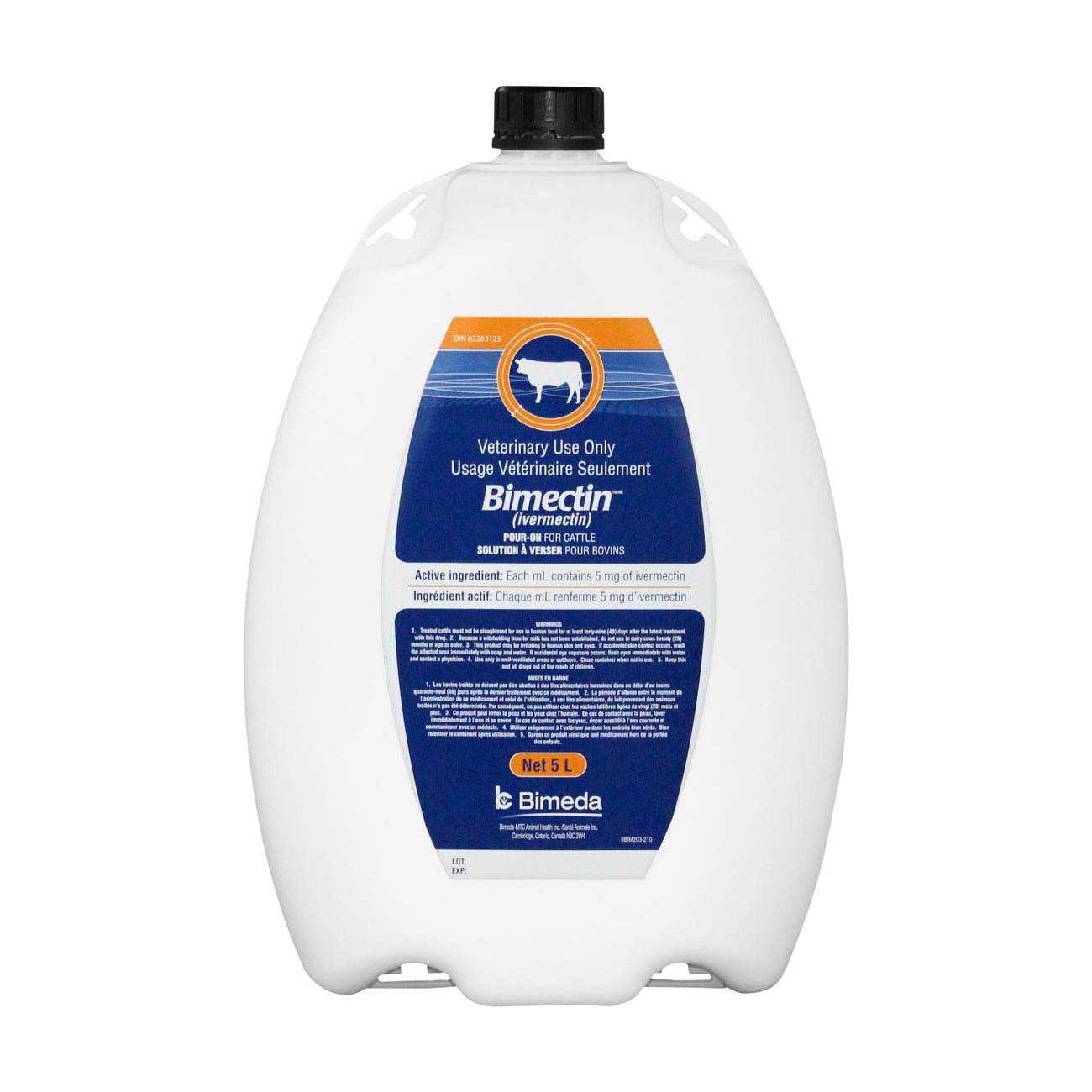
If your cattle are getting a pour-on this fall, the same questions come up: how much goes on each animal, how long before the cattle can go for slaughter, can it go on in the rain, and can the dairy heifers have it. This guide answers those questions for Bimectin Pour-On using only what Bimectin's Canadian label and Health Canada's Drug Product Database say. It is not a deworming plan; your veterinarian sets the timing for your herd.
What Bimectin Pour-On is
Bimectin Pour-On is a non-prescription veterinary drug, DIN 02283123, registered with Health Canada to Bimeda-MTC Animal Health Inc. Health Canada's Drug Product Database lists it as "(IVERMECTIN) POUR-ON FOR CATTLE": a topical solution with 5 mg of ivermectin per mL, for cattle, with a status of Marketed.
The label describes it as "a clear, blue coloured liquid containing 5 mg of ivermectin per mL (0.5% w/v)" and says it "is formulated for external use only in cattle; it should not be used in other species." It comes in two sizes, 5 L and 20 L, and we carry both: Bimectin Pour-On 5 L and Bimectin Pour-On 20 L.
Is Bimectin the same as ivermectin?
Bimectin is a brand name; ivermectin is the active ingredient. The pour-on contains one medicinal ingredient, ivermectin, at 5 mg per mL. Other ivermectin pour-ons are separate registered products with their own labels, so read the label of the product you actually have rather than assuming the directions are the same.
Bimectin Injection (DIN 02275112) is also a different product. The Drug Product Database lists it as an injection for cattle and swine, given subcutaneously, at 10 mg of ivermectin per mL, with its own label, dose and withdrawal. We list it as Bimectin Injection 500 mL. Everything below is about the pour-on only.
What the label says it is for
From the label: "Bimectin™ Pour-On applied at the recommended dose level of 500 µg of ivermectin per kg of body weight is indicated for the treatment of parasitic infections and infestations due to gastrointestinal roundworms, eyeworms, lungworms, grubs, biting and sucking lice, mites and hornflies in cattle."
The label then lists the individual parasites by name. One note on mange from the label: "If psoroptic mange is to be treated, Ivermectin Injection for Cattle is recommended."
How much Bimectin Pour-On per cow?
The label rate is 1 mL per 10 kg of body weight, "applied along the top-line in a narrow strip extending from the withers to the tail head".
Worked from that rate (our arithmetic, not a label table):
- a 250 kg calf: 25 mL
- a 400 kg yearling: 40 mL
- a 600 kg cow: 60 mL
At 60 mL a head, a 5 L container covers about 83 cows of that weight, and a 20 L container about 333. Weigh or estimate weights honestly: the dose is set by body weight, so a guessed-low weight means a low dose.
For the 5 L and 20 L packs the label says to "Use dosing equipment compatible with Bimectin™ Pour-On", and warns that other dosing equipment "may be incompatible, resulting in locking, incorrect dosage and leakage." It also gives step-by-step instructions for connecting the dosing gun and draw-off cap; follow those on the label.
Can you pour it on wet cattle or before rain?
No, not according to the label. Under Cautions: "Cattle should not be treated when hair or hide is wet since reduced efficacy will be experienced. Rain falling on cattle in less than 2 hours after dosing may result in reduced efficacy."
The label adds that ivermectin's activity "will be impaired if the formulation is applied to areas of skin with mange scabs or lesions or with dermatoses or adherent materials, e.g. caked mud or manure." So a dry day and a clean top-line matter, and that is worth planning around in a wet fall.
Bimectin Pour-On withdrawal time
The meat withdrawal on the label: "Treated cattle must not be slaughtered for use in human food for at least forty-nine (49) days after the latest treatment with this drug."
For dairy: "Because a withholding time for milk has not been established, do not use in dairy cows twenty (20) months of age or older."
Count the 49 days from the last treatment, not the first, if an animal is treated more than once.
How long does it keep working?
The label has a "Persistent Effect" section that names specific parasites and how long after treatment the label says infections or infestations acquired are controlled; the periods it lists run from 14 to 49 days depending on the parasite. Read that section for the parasite you are dealing with rather than relying on a single number.
The label also says: "Consult your local veterinarian or entomologist for the most effective timing of applications."
Fall treatment and cattle grubs
The label raises timing specifically for cattle grubs. Its Cautions say: "To prevent potential secondary reactions when treating infections with cattle grubs, consult your veterinarian on the correct timing of treatment." That is a question for your vet, who knows your area and your herd; this guide does not give treatment dates.
Handling, storage and disposal
From the label's Warnings:
- "This product may be irritating to human skin and eyes. If accidental skin contact occurs, wash the affected area immediately with soap and water. If accidental eye exposure occurs, flush eyes immediately with water and contact a physician."
- "Use only in well-ventilated areas or outdoors. Close container when not in use."
- "Keep this and all drugs out of the reach of children."
Storage: "Store at controlled room temperature, 15-25°C. Store bottle in carton to protect from light." The label also marks it "Flammable - keep away from heat, sparks, open flame or other sources of ignition." It notes that the blue colour fades in light and that this "does not reflect loss of potency", but that "prolonged exposure (i.e., weeks) to light can also result in a gradual decline of ivermectin potency in the formulation." So keep the jug in its carton between uses, not on the barn windowsill.
On disposal, the label says containers and residual contents "should be disposed of safely (e.g. by burying or incinerating) as free ivermectin may adversely affect fish or certain water-borne organisms." Keep rinse water and empty jugs away from dugouts and creeks.
Where to find it
We carry Bimectin Pour-On 5 L and Bimectin Pour-On 20 L, along with the rest of our cattle dewormers and parasite control range and the Bimeda line. Each product has its own label; read it before use. Comparing options? Our cattle lice pour-on guide puts Bimectin Pour-On beside Lice-Away and BackLine by label, and Safe-Guard for Cattle: Fenbendazole Dose, Withdrawal and the Canadian Label reads the fenbendazole drench label the same way. Horse owners: see our horse dewormer guide instead, because Bimectin Pour-On is labelled for cattle only.
Sources: Health Canada Drug Product Database, BIMECTIN (IVERMECTIN) POUR-ON FOR CATTLE (DIN 02283123, Bimeda-MTC Animal Health Inc.) and BIMECTIN (IVERMECTIN) INJECTION FOR CATTLE AND SWINE (DIN 02275112), viewed October 2026; the Bimectin Pour-On Canadian label (8BIM212-210), as reproduced on drugs.com (Animalytix, updated 2026-05-28), viewed October 2026.